• Updated Hut Maintenance Figures

    When back-country hut fees increased several years ago, I wrote with some disappointment about how I saw hut fees as being the price of being honest. I still think that, but it’s not something up for negotiation right now.

    Back then, I also tried to compare the expenditure on maintenance of back-country huts with the revenue from back-country hut tickets. This wasn’t fully possible because a DOC accountant told me that spending between regular back-country huts and Great Walk huts couldn’t be separated, despite the user-pays component of the latter not actually coming from back-country ticket and pass sales.

    In other words, the $16.5 million figure for expenditure on “huts” in DOC’s 2009 Annual Report couldn’t be split between two classes of hut which are treated radically differently where maintenance is concerned, and so couldn’t be nicely compared with the user pays revenue streams for those classes of huts. Comparing hut ticket revenue with $16.5 million of expenditure wasn’t very meaningful when the bulk of that spending is probably going to maintenance of huts with user-pays fees sourced elsewhere.

    Lately, in April we had a forum conversation on the NZ Tramper website, and this question of comparison came up again. Trying my luck a second time I fired off an Official Information Act request, and this time it seems to have gone to someone much more helpful. I received the exact figures I asked for. I didn’t bother to ask specifically about expenses on Great Walk and similar huts because they don’t interest me as much, but here are the comparisons for regular back-country hut revenue and expenditure for the last few years.
    (more…)

  • Unofficial Tracks in Egmont National Park

    16171535318_71ef43d7c5_n-8761728
    Track Closed signs in Egmont National Park.
    16172888069_f5990f07a6_n-7017941

    I hope that some of the quotes in Wednesday’s article via the Taranaki Daily News have been printed incorrectly or out of context.

    In it, a senior DOC ranger, referring to Egmont National Park, comments about people unofficially marking and maintaining old tracks, which DOC no longer officially maintains. Sometimes people even mark new tracks of their own making!

    The problem? Other people might follow them. They might get lost or distracted from DOC’s official tracks. The unofficial routes might not have been routed or maintained to the same safety standards as DOC would have ensured. It might be harder to find people if they get lost, because they’ll be away from the main tracks.

    I have mixed thoughts about this, but mostly dismay with DOC’s apparent stance. There may be issues where people are causing significant damage to the surrounding environment by marking and maintaining their tracks. If people are placing giant markers that are damaging or out of character, or are themselves creating a hazard in ways which rival what the nearby outdoor creates all by itself, then fair enough to raise those specific instances. But beyond this I’m struggling to see an issue with people using and marking alternative routes.
    (more…)

  • Browsing Historic Topo Maps with MapsPast

    If you like topo maps, and especially trawling through historic topo maps of New Zealand, then check out the new MapsPast website, thrown together by Matt Briggs.

    Maps are great. For me, looking at maps and understanding what’s around is a fundamental aspect of tramping and getting outdoors to explore. Maps change over time, though. Whilst terrain doesn’t change rapidly, representation of features on maps often do. Locations of huts, campsites, tracks and common routes is often a fluid thing, and so looking at older maps can open windows to the past.

    In New Zealand we’re very fortunate that good quality survey information is surveyed, produced and made freely and easily available by the government, most recently handled by Land Information New Zealand (LINZ). The current flagship map series that’s most popular in tramping circles is the 1:50000 Topo50 series, which replaced NZMS260 a few years ago. But as new series’ and new editions of series’ are published, historic information can sometimes become obscured or lost.
    (more…)

  • Good LandSAR Publicity

    This morning’s Dominion Post has some fab publicity for New Zealand’s LandSAR organisation, derived from a couple of recent high profile incidents in the Tararua and Rimutaka Ranges in the lower North Island.

    The first article profiles a couple of people who volunteer their time and expertise to work with Police who usually coordinate their types of searches. The second article describes some of the mechanisms and processes of a systematic LandSAR operation in New Zealand, and a summarised history of how it came to be this way.

    Both make worthwhile reading.

    Various other links of relevance: New Zealand Land Search and Rescue, LandSAR Wellington, Police dog Thames found on High Ridge in the Tararuas, and Runner found in the Rimutaka Range.

  • Ordering of Priorities

    I recently attended a great talk, courtesy of a person whose group of four was rescued from the Tararuas less than a year ago. The incident was not reported by media. If it had been then it probably would have attracted much criticism.

    They had made a series of bad decisions, then become stuck in a situation where, due to exhaustion there was nowhere they could go. They activated a Personal Locator Beacon, which at first mis-represented their position as being safely in a hut. To its credit, the RCCNZ made no assumptions about the safety of the group. Weather prevented a helicopter from reaching them immediately, and so a small fast-moving LandSAR team was sent on foot towards the hut where they were initially believed to be. The helicopter finally made it through. Based on hut book comments they were eventually found some distance away, having endured 170 mm of rain overnight with no adequate shelter, and with a dire outlook for the near future had help not arrived.

    It’s uncommon to hear people speak so openly in front of audiences about such an experience, knowing mistakes were made. The speaker was perfectly humble about the group’s mistakes, and I really appreciate the attitude with which the talk was presented.

    I asked about what might have happened if they’d not had the PLB. He treated the question as theoretical on the grounds that he’d never go out without a PLB, but otherwise guessed that there could easily have been deaths had they not had it. This philosophy about never venturing out without a PLB is consistent with a recent media push of promoting Personal Locator Beacons above all other aspects of back-country safety, at least as far as I can tell. I think this struck a chord for me, because for as useful and important as I see PLBs, I struggle to justify carrying one without carrying the type of portable shelter which would not only have kept them warm and dry until help arrived, and probably prevented deaths if rescue had taken an extra day, but very possibly could have prevented the entire emergency to begin with.

    Any rescue is useless, as is a PLB, if you can’t stay alive long enough for that help to arrive. Requested help can often take hours or days, depending on circumstances. As recently as two years ago, two people with perfectly adequate communications could not be reached by rescuers before it was too late. Until help arrives, self reliance is all you have. To me, thinking of a typical tramping scenario combined with the NZ weather’s high tendency for precipitation, good portable shelter is a very important component for heightening chances of survival if something goes wrong.

    PLBs are also not essential in every rescue which involves them. Help will still arrive, without doing anything, if you’ve followed a few habits like telling a reliable person of your intentions, then sticking to them, so that search coordinators can make efficient estimates of where they’re likely to find you once you’re reported overdue. Having a PLB in these situations can obviously result in much less stressful time and be extremely convenient for all concerned, but it’s not as essential if you’re likely to be quickly found and rescued anyway…. after being reported overdue.

    In this post I’m not trying to argue about whether PLBs should or shouldn’t be carried. I still think they’re a good idea, even moreso under certain circumstances, and I carry one myself. Here, however, it’s more the ordering of priorities which I’m finding interesting.

    With so much recurring media discussion about how people are automatically idiots when they don’t carry PLBs (check out the colourful comments thread), I do struggle to see the logic of how we still see many people apparently not carrying reliable portable shelter for staying warm and dry, let alone some of the other basics of the Outdoor Safety Code, like telling someone where you’re going. We barely even talk about preventative stuff like portable shelter in the media, compared with the amount of talk about reactive stuff like PLBs. Personally, however, I’d rate reliable portable shelter as being more important than a PLB for most circumstances, if it were necessary to choose between them.

    …and now to try something…

    All of this reminded me of an old NASA-sourced exercise from many years ago. The exercise, happily still around on the internet, posits a scenario of leaving a crashed spaceship on the daytime side of the Moon, needing to reach a mother ship, 200 miles away. Participants are given a list of equipment they can take, and must prioritise items in order of importance.

    [Stop reading here if you want to try the exercise without seeing a discussion of answers.]
    (more…)

  • A New Era for Outdoor Safety Training

    In February I wrote about the structural changes in the Mountain Safety Council, with an expression of concern. A reference which I’d included if I’d known of it was the the MSC’s own explanation of the changes, which is buried in the depths of its website.

    The bubble diagram towards the end of that page represents what’s happening quite well. The MSC is removing nearly all of its outdoor safety training, will no longer be setting any safety standards, and instead will shift to a more hands-off model of producing safety messages and collecting information. Reasoning is provided, but the end result is that most of the excellent training programmes and material which the MSC produced, for amateurs and by amateurs, will no longer be available through the Mountain Safety Council in future.

    This has caused concern in many circles, which I’m inclined to agree with. For roughly five decades now, the Mountain Safety Council has been synonymous in New Zealand with research, setting of standards, training and expertise for bushcraft, river safety, alpine and climbing skills, avalanche safety, firearms safety, outdoor leadership and outdoor first aid. It’s impressive that the sustained activity in these has mostly come from volunteers, not just to help around the edges but to be fundamentally involved, become experts and to train others up to a high level.

    As linked in February, the upcoming move to do away with most training programmes, and then sideline volunteers from the organisation as newly superfluous to requirements (unless they want to simply help with token tasks around the edges) has not gone down well with some of those volunteers.
    (more…)

  • Tramping – A New Zealand History, by Shaun Barnett and Chris Maclean (my thoughts)

    Until now there’s been a major omission in publications about tramping. So far all we’ve seen are route guides, narratives or yarns, tourism guides, diaries, local histories, blogs and other websites, biographies and autobiographies, newspaper articles, safety manuals, fiction, club newsletters and journals, “best of” publications of journals, hut book rants about others leaving rubbish behind, histories of topics which are associated with tramping, collections of scenic photographs, dramatic re-creations for television, archived descriptions of accidents, poetry, commercial magazines, calendars, promotional material, and personal accounts illustrated with humorous comic imagery.

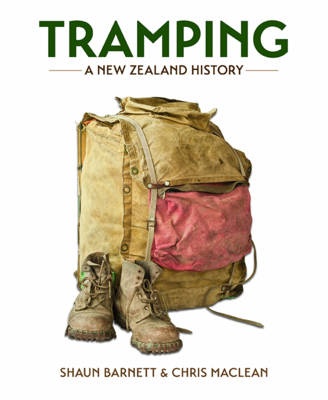
    cover_tramping_nz_history

    It’s no wonder that someone has finally attempted to exploit the seriously under-represented genre of comprehensive authoritative histories about tramping in the form of large coffee table books. The result is Chris Maclean’s and Shaun Barnett’s Tramping – A New Zealand History.

    I first heard of this book shortly before a seminar given by the authors in September 2013. I attended the seminar, and left with optimism. A year later, the book was released. It displays a Mountain Mule and a pair of old boots on the cover. The book weighs 2.5 kg.

    Below are my thoughts, and I’ve tried really hard to keep these thoughts shorter than the book itself. If you’re interested, some alternative sources of info are the book’s official Facebook page, an interview by Kim Hill with the authors that was broadcast on Radio NZ, a book extract published in the NZ Herald, or brief reviews on NZ Bush Adventures, Beatties Book Blog, the Otago Daily Times, and Wild Magazine.
    (more…)

  • Trip: Tapokopoko Kotumu Loop

    16171916418_90fe7b0a32_n-4726502
    Alistair in typical surroundings.

    It’s easy to overlook the Orongorongo Valley and surrounding Rimutaka Range, especially with additional tramping options so nearby, notably the Tararuas. That’s something I’ve often been guilty of. Until relatively recently, my most common perception of the range has been from the parts which are easy to reach without much commitment like Mount McKerrow, Cattle Ridge and Turere Stream. Generally that corner of the range, up and down the Orongorongo River with its lolly scramble of locked private huts and batches hidden in the trees. It’s great for accessibility, but comes with a feeling of being less remote.

    Last November was a wake-up call, when (mostly on Alistair’s inspiration to re-live his childhood) we didn’t just walk across to the Wairarapa coast so much as found an interesting way to do it. That time we climbed to Tapokopoko, then headed north before dropping into a less visited valley of the Tapokopoko Stream. More recently, in the effort I’m about to describe, we ventured into chapter two of Alistair’s inspiration, following the ridge line south of Tapokopoko.

    Our exact plan wasn’t clear until close to starting, but with no significant rain for weeks and with fully clear, sunny days in the forecast the potential for being ambitious was encouraging.

    Dates: 23rd – 25th January, 2015
    Location: Rimutaka Forest Park, Catchpool Valley Road-end.
    People: Alistair, Maarten, Bernie, WeiMin, Jessie and me.
    Huts visited: Paua Hut (2 nights outside)
    Route: In to Paua Hut for Friday Night, nav up to Tapokopoko (.843), south to .703, up The Peak (.864), further south to sidle under Kotomu (.786), down Red Rocks Stream back to the Orongorongo, and Paua Hut again for Saturday night.
    Also see: Maarten wrote a trip report for the WTMC newsletter.
    [Photos]
    [map:https://93a12629bf06.ngrok-free.app/wp-content/uploads/2015/01/20150125-tapokopoko-kotumu-loop.gpx%5D

    This post is a trip report. You can find other trip reports about other places linked from the Trip Reports Page, or by browsing the Trip Reports Category.

    On a summer’s night, there was still plenty of daylight available when we began the easy walk at about 6.45pm on Friday evening, towards the club’s Paua Hut on the true left of the Orongorongo River. Along the way we kept an eye open for the junction with Browns Track, but I can never remember the details of where it begins. Expediency won out over attention to surroundings.
    (more…)

  • What’s up with the Mountain Safety Council?

    From this morning’s news, it sounds as if the Mountain Safety Council is going more professional, doing away with amateur instructors and, for the most part, even training people at all.

    I’ve never been a direct member of the Mountain Safety Council, but I’ve attended some courses and read training material that’s published alongside those courses like the Bushcraft Manual, the Outdoor First Aid Manual, and the Alpine Skills Manual. I’ve also attended courses run through my local tramping club with MSC-accredited instructors and MSC course material.

    From my limited exposure I’ve been impressed with how the system works. Once you get into the Mountain Safety Council beyond the lowest levels, it doesn’t just aim to teach you stuff. It encourages you to get involved in a progressive programme towards becoming an expert in the field, remaining updated with the latest research and techniques, and ultimately becoming an instructor who can train others at an expert level.

    It’s sad to read, therefore, that there’s apparently now a plan to flatten this structure: no longer allowing volunteers to have training accreditation, and at best using amateurs as vassals to help out with relatively simplistic tasks like “deliver safety messages” instead of being a serious part of the process. Waikato Branch executive member, John Greenwood, seems to have a good point in the above-linked article that volunteers would have little reason to stay involved with the Mountain Safety Council. After all, what’s in it for them?
    (more…)

  • Not my preferred form of agony

    Here’s a quick pointer towards the Tararua Fastest-Known-Times site, which has been spread around social media in the last few days. It caters to a mentality which doesn’t so much appeal to me, but which has a good following. My own preferred form of back-country turture would be one of pushing through leatherwood at 100 metres an hour. 🙂

    There’s at least a loose history of running in the Tararuas, going back at least as far as the likes of Sam “Big Mac” McIntosh, Bill Gibbs and friends in the 1940s, as documented by Chris Maclean’s Tararua history. More recently there are certain people around who have always looking at challenges like running an SK, or a Southern Main Range loop as a day-trip, or otherwise. It’s grown in the range as a sport in the past few years, however, with the influence of local running groups and relatively recent events like the Tararua Mountain Race and the Jumbo Holdsworth Race, as well as a growing community in nearby centres.

    The increased interest naturally comes with new challenges, particularly where safety and skills are concerned, but hopefully the protocols around what’s acceptable in a new activity will become well established over time. And yes, I know there are plenty of people out there who already think carefully about this.

    On the off-chance that you enjoy this type of thing, you might also like Taranaki Speed Records, which documents the speed records for such enlightening achievements as the most times ascending (and descending) Mount Taranaki in a 24 hour period.