Tag: book

  • Protecting Paradise, by Dave Hansford (my thoughts)

    Before I launch into this, I’ll insert a word for one of the best presentations I’ve ever seen on how the world’s going, and the impact we’ve had on it.

    Less than a week before his death in May 2001, Douglas Adams gave a brilliant talk at the University of California titled “Parrots, the Universe and Everything“. He conveys many of his experiences and insights on extinction, mostly derived from his time producing the BBC’s Last Chance to See radio series in 1989. Adams’ 2001 talk is helpfully preserved online by Ted (link above) and I highly recommend it. He’s an excellent and humorous speaker yet his points are serious and well made. If you’ve limited time, jump to 26 minutes for his amusing experiences with the Kakapo, which he declares as a favourite of all the animals he saw.

    Now, onto this largely unrelated book…

    Protecting-Paradise_cvr-600-max-800

    The full title of the book is Protecting Paradise: 1080 And The Fight To Save New Zealand’s Wildlife. It’s authored by Dave Hansford, published by Potton & Burton, and was released in October 2016. The publisher’s website seems to claim 250 pages, but the main text of the printed edition actually finishes on page 265. This is followed by 2 pages of acknowledgments, 6 pages of appendix, 31 pages of references and a 14 page index. That’s around 318 pages total. The 265 pages of regular text is divided into 22 chapters, averaging around 11 to 12 pages each. The book retails for $34.95, but it’s often possible to get discounts if you shop around, or check if the local library has it.

    265 pages might sound daunting at first, but it well written. Chapters are well structured without being too long. Editing is of high quality. It’s easy to read. It’s not necessary to have a scientific background.

    If this review isn’t enough, you’ll find an alternative review at SciBlogs, plus the author’s been interviewed by Jamie Morton of the NZ Herald and by Wallace Chapman on RadioNZ.

    BACKGROUND:

    Protecting Paradise has been touted as a book about use of the 1080 toxin in New Zealand. 1080 is primarily used by the Department of Conservation for controlling rats, possums and stoats on the conservation estate, and by OSPRI (formerly the Animal Health Board) for controlling bovine tuberculosis, which largely spreads through possums. Right from the front cover it’s clearly framed as a 1080 book, yet it’d be a disservice to the author’s efforts to suggest it’s only about 1080, because the book is not a just raw explanation of 1080 and what it does. Rather, Dave Hansford has produced a comprehensive guide to the history, present and future of pest impact and pest control in New Zealand, including its social impacts.

    It’s mildly ironic that a large component of conservation in New Zealand is about killing things. Explaining 1080’s role and workings in pest control is well covered, but it’s appropriate that the Protecting Paradise narrative goes well beyond this. The author’s spent large parts of the book examining what is increasingly becoming a social and ethical issue in New Zealand. Alongside the objective analysis, he’s spoken to a wide range of people to draw a picture of how pests, pest control and 1080 affects them, and what it means to them.

    Lane read my mind, fixed me with a level stare: ‘Would you drink that water, knowing it had 1080 in it?’ I said that I wouldn’t, and I meant it. I don’t share his blanket antagonism to 1080, but most of us might empathise with his experience. We all carry the caution gene. What’s more, we like to think that we carry a sense of natural justice: there’s something understandably disturbing about a Government dropping poison from the air—against the express wishes of some—around our homes and across our treasured spaces. That’s powerful, almost Orwellian, imagery, and it’s a potent anathema.

    —page 76.
    (more…)

  • Tramping – A New Zealand History, by Shaun Barnett and Chris Maclean (my thoughts)

    Until now there’s been a major omission in publications about tramping. So far all we’ve seen are route guides, narratives or yarns, tourism guides, diaries, local histories, blogs and other websites, biographies and autobiographies, newspaper articles, safety manuals, fiction, club newsletters and journals, “best of” publications of journals, hut book rants about others leaving rubbish behind, histories of topics which are associated with tramping, collections of scenic photographs, dramatic re-creations for television, archived descriptions of accidents, poetry, commercial magazines, calendars, promotional material, and personal accounts illustrated with humorous comic imagery.

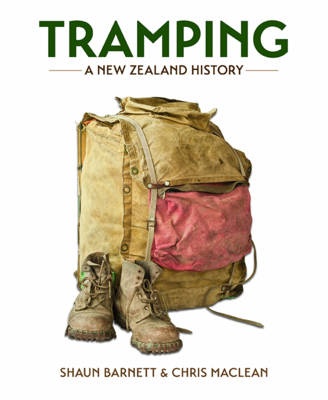
    cover_tramping_nz_history

    It’s no wonder that someone has finally attempted to exploit the seriously under-represented genre of comprehensive authoritative histories about tramping in the form of large coffee table books. The result is Chris Maclean’s and Shaun Barnett’s Tramping – A New Zealand History.

    I first heard of this book shortly before a seminar given by the authors in September 2013. I attended the seminar, and left with optimism. A year later, the book was released. It displays a Mountain Mule and a pair of old boots on the cover. The book weighs 2.5 kg.

    Below are my thoughts, and I’ve tried really hard to keep these thoughts shorter than the book itself. If you’re interested, some alternative sources of info are the book’s official Facebook page, an interview by Kim Hill with the authors that was broadcast on Radio NZ, a book extract published in the NZ Herald, or brief reviews on NZ Bush Adventures, Beatties Book Blog, the Otago Daily Times, and Wild Magazine.
    (more…)

  • NZ Tramping History released

    Last year I wrote about the upcoming publication of a new Tramping History book, researched and authored by Shaun Barnett and Chris Maclean.

    The book finally had its launch last week, and is now available. I’m waiting for my copy (all 2.5kg of it) to arrive, and looking forward to browsing through it.

    Meanwhile, if you’re interested, check out Kim Hill’s radio interview with the authors last Saturday morning, or the book’s Facebook page.

  • NZ Tramping History in the works

    There are several good-looking books on my reading list right now. To add to it, last week I attended a seminar, by Chris Maclean and Shaun Barnett, who spoke about their upcoming book titled Tramping, a New Zealand History. The book received a grant from the Ministry of Culture & Heritage, who hosted this seminar.

    The new book is still in its draft stages, but it looks as if it’ll be a good and interesting read once it’s published. You can listen to a podcast of the seminar via the New Zealand History Online website, or here’s a more specific link. The authors have also created a Facebook page to help collate material and discussion of the book.

    Both authors are well accomplished. Chris Maclean has authored a variety of histories, particularly based around the Wellington region. He’s probably best known in tramping circles for his detailed history of the Tararua Range, titled Tararua: The Story of a Mountain Range, first published in 1991 and which continues to pop up on Trademe on occasion, but more recently he authored an historic biography—Stag Spooner: Wild man from the bush. Shaun Barnett has a collection of well-authored titles, including co-authoring the recent Shelter From The Storm. He’s also well known for his scenic photography, and for activities such as editing of Wilderness Magazine (formerly) and the Federated Mountain Clubs Bulletin,

  • Collins Ultimate Navigation Manual, by Lyle Brotherton (a review)

    Collins Ultimate Navigation Manual, by Lyle Brotherton

    I don’t normally refer to material without a direct New Zealand connection, but I’ve made an exception in this case. In my kiwi-centric world (at least on this website) I’m very interested in outdoor navigation. Globally the Collins Ultimate Navigation Manual by Lyle Brotherton is a highly recommended resource. I haven’t seen it on retail shelves in New Zealand, but it’s accessible fairly cheaply with an online order via an NZ web retailer such as Fishpond, although you’ll need to wait for the book to be mailed from the UK

    I was excited when I first heard about this book. I’ve seen it informally referred to as something that resembles a complete and authoritative guide to navigation. The book itself doesn’t state this, but still claims via its preface to be “the most comprehensive and easy-to-use navigation manual ever made available”, and “a landmark in land navigation”.

    More specifically, the book considers what its author refers to as “micronavigation”, which is essentially described as [my translation] the form of land navigation that involves connecting together short legs of movement through a terrestrial environment to successfully form a lengthier journey. In other words, it’s a guide to virtually all types and tricks of navigation that are normally required for finding one’s way through the back-country.
    (more…)

  • Safety In The Mountains (review)

    Safety in the Mountains, 11th edition cover

    I’ve never read a copy of Safety in the Mountains until now. It’s a booklet, first published in 1937 by Federated Mountain Clubs (FMC), to collect important points of safety for exploring the back-country, and designed as a carry-with-you reference guide. Over 75 years, 130,000 copies have now been printed. The 11th and latest edition of 2012 was launched earlier this month.

    Not having read previous editions makes me inadequate to comment on changes or make other comparisons with what came before, so here I express my impressions of the 11th edition from an isolated viewpoint. I’ll also state a disclaimer for a potential conflict of interest, because I’m indirectly a member of Federated Mountain Clubs (via the Wellington Tramping & Mountaineering Club), and tend to be aligned with much of its advocacy.

    About the book

    The text says it best: “This booklet is intended as a collection of reminders for use in the field rather than to replace any instruction manual, or textbook. They are for the guidance of readers and are binding on fools.”

    (more…)

  • Tararua Footprints Online

    Many people who visit the Tararuas will have a copy of Merv Rodgers’ book from 1996, Tararua Footprints, on their bookshelf. Historically it’s one of the more authoritative guidebooks on the Tararuas, talking about river systems and valleys and how the routes fit together. It covers different territory from the more recently published Tararua Adventure Guide, which is a more specific guide to specific things to do in the range.

    Lately, Tararua Footprints has become very hard to track down, but very awesomely the author has now donated the text to the Tararua Tramping Club for a new online edition.

    Although it’s now 16 years out of date, geography doesn’t change much in that time and most of the information is still very relevant. The longer term intent of the TTC is to turn the online edition of the book into an up-to-date working guide to be edited in an ongoing fashion and be the “definitive Tararua Range route guide”.

    It’s certainly worth checking out next time you venture into the Tararuas.

  • A Crossing to Remember: A Tararua Southern Crossing in 1920

    Several days ago, I noted that it’s almost 100 years since the Southern Crossing Track was completed, which is pretty cool. This, however, was only the beginning of a significant tourism venture for both the Otaki and Wairarapa regions. At a time when the northern parts of the Tararua Range had barely been explored, the next phase of the project would be to market the walk across the southern end to potential tourists, convincing people that a visit to the Tararua Range could be a relaxing escape into the outdoors, away from the hustle and bustle of everyday life.

    Earlier, in 1907, Willie Field and Frank Penn (editor of the Otaki Mail) had combined with a botanist, Bernard Aston, to enthusiastically promote and raise funding for the cutting of the track. The track was completed in 1912, and committees were formed on both sides of the range to plan for building of huts specifically so that walkers could stay the night. The committee on the Wairarapa side was more successful in raising funding, with the original Alpha Hut complete by 1915 and Upper Tauherenikau Hut in 1917. Tramping clubs soon began to form—the Tararua Tramping Club (TTC) having its inaugural meeting in 1919 thanks to the efforts of Willie Field and Fred Vosseler. Young members of a fledgeling Victoria University Tramping Club were also exploring, with an allegedly less mature attitude than a more “refined” TTC.

    In 1920, to fan the potential of the Southern Crossing as a major tourist attraction, particularly for his own Otaki region, Frank Penn produced a 40 page booklet, forwarded by Fred Vosseler. The first part of the book was titled Across The Tararuas and explains the wonders of a Southern Crossing in detail and with photographs. The second part was titled Beautiful Otaki, and describes a history of the Otaki district. The complete book was designed as a marketing tool to entice tourists to visit the district, then to take advantage of the excellent railway transport on both sides of the range by walking the amazing route across the range between them. Scattered throughout the booklet, especially during the latter section, are a variety of enthusiastic advertisements for local holiday businesses and the New Zealand Government (“a holiday once a year is a good investment!”) Tourist Bureau.

    Across The Tararuas, the first half which I’ve reproduced below, is one of the very early comprehensive descriptions of a typical Tararua Southern Crossing in existence. The text is clearly written with a marketing intent, from the perspective of an anonymous protagonist being guided in a group by an anonymous guide. The wonder and glory of the Tararuas is expressed repeatedly, albeit with caution regarding how to react in situations of potential bad weather. It’s likely that the photos and descriptions are collected from several experiences. The remainder of the book, although not reproduced here in text, can be read via scanned pages in the gallery below. My personal favourite feature is the one digit phone number in the advertisement for the local Motor Garage and Livery Stables, on page 36. (Phone 7—Otaki.)
    (more…)

  • NZMS 260 and 262: Our Metric Topographical Heritage, edited by Graeme Jupp (review)

    Topographic maps worldwide often appear utilitarian, if not a little boring graphically. By comparison the new 260s were stylish and modern without losing any utility. They were undoubtedly among the best looking topographic maps in the world.

    —David Balm, In Order to Make a Good Impression: Printing 260 series topographic maps, 1976-1984, (reproduced in the book being reviewed)

    Cover image of NZMS 260 and 262: Our Metric Topographical Heritage, edited by Graeme Jupp

    This is a review of Graeme Jupp’s recently published booklet, titled “NZMS 260 and 262: Our Metric Topographical Heritage”, which was published in February 2011 as part of the CartoPRESS series by the New Zealand Cartographic Society. I’m not giving a complete qualified review, because I’m neither a cartographer nor am I very familiar with much of the history the material to comment on accuracy. It’s more of a perspective from someone who’s enjoyed using New Zealand’s topo maps over the last few years from a tramping perspective. If anyone notices mistakes in some of my comments to do with mapping history or technical issues, please feel welcome to correct me in the comments below. An alternative review by Shaun Barnett has been published in FMC Bulletin 184 from June 2011 (see here for a download link), which has been republished by the NZ Cartographic Society.

    If you’ve spent any of the last several decades using New Zealand’s official topo maps to plan interesting trips, you might find a moment to turn an eye to a short collation of recent cartographic history. This book combines a history with a comprehensive tabular appendix of maps. The combination of the history and the tables means it will make a handy reference item to have on the shelf for many people with an interest.

    The 260 and 262 map series are now obsolete, having respectively been replaced by the Topo50 and Topo250 series as of September 2009, but until that time they became extremely popular, and many are still in circulation today. As concluded by the editor, more than 2.8 million maps of the 260 series, and a further 408,000 maps in the 262 series (which shared the same geodetic datum but was drawn to a different scale) were printed between 1978 and 2009. Production of the 260 and 262 series provided a platform, and also established techniques and technologies upon which New Zealand’s topographic map-making continues to be built. The influence of this period of time in the production of maps in New Zealand seems hard to argue with.
    (more…)

  • Huts: Untold stories from back-country New Zealand, by Mark Pickering (review)

    Huts, by Mark Pickering

    This is the second book I’ve read by Mark Pickering, the first having been A Tramper’s Journey, which I liked (the review is here). He’s written many books, and this is a topic that Mark Pickering is especially suited to, having a strong interest in huts and having visited over 1000 back-country huts already. His latest book was released in time for Christmas 2010. Huts: Untold stories from back-country New Zealand retails for $50, or $49.99 if you take the effort to shop around.

    Production quality is generally nice, with good authoring and editing, although see my comment below about printing. This book is very heavy. It’s a paperback, but don’t let that fool you. It’s 384 big pages on good, glossy paper. Large numbers of photographs, often using half a page at a time, ensure the text isn’t too dense and the reading remains quite easy. Reading one or more chapters in a short sitting is very feasible. The weight and dimensions mean it’s not the sort of book that would typically be stuffed into a pack for weekend reading, except by people who like to show off.

    Background

    The title suggests that this is a book about huts. It is, but it’s even more-so a book about the history of the back-country, and how all of the 1000—1500 back-country huts (the exact number depends on one’s criteria for counting) came to be. The blurb on the back of the book begins with “If huts could talk, they could tell the whole history of the back-country”, and this is a good summary of what you’ll find inside. It’s a history built around the structures which, today, are mostly used for recreation.
    (more…)