Tag: history

  • Browsing Historic Topo Maps with MapsPast

    If you like topo maps, and especially trawling through historic topo maps of New Zealand, then check out the new MapsPast website, thrown together by Matt Briggs.

    Maps are great. For me, looking at maps and understanding what’s around is a fundamental aspect of tramping and getting outdoors to explore. Maps change over time, though. Whilst terrain doesn’t change rapidly, representation of features on maps often do. Locations of huts, campsites, tracks and common routes is often a fluid thing, and so looking at older maps can open windows to the past.

    In New Zealand we’re very fortunate that good quality survey information is surveyed, produced and made freely and easily available by the government, most recently handled by Land Information New Zealand (LINZ). The current flagship map series that’s most popular in tramping circles is the 1:50000 Topo50 series, which replaced NZMS260 a few years ago. But as new series’ and new editions of series’ are published, historic information can sometimes become obscured or lost.
    (more…)

  • Tramping – A New Zealand History, by Shaun Barnett and Chris Maclean (my thoughts)

    Until now there’s been a major omission in publications about tramping. So far all we’ve seen are route guides, narratives or yarns, tourism guides, diaries, local histories, blogs and other websites, biographies and autobiographies, newspaper articles, safety manuals, fiction, club newsletters and journals, “best of” publications of journals, hut book rants about others leaving rubbish behind, histories of topics which are associated with tramping, collections of scenic photographs, dramatic re-creations for television, archived descriptions of accidents, poetry, commercial magazines, calendars, promotional material, and personal accounts illustrated with humorous comic imagery.

    cover_tramping_nz_history

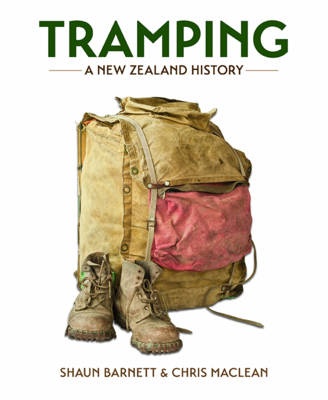
    It’s no wonder that someone has finally attempted to exploit the seriously under-represented genre of comprehensive authoritative histories about tramping in the form of large coffee table books. The result is Chris Maclean’s and Shaun Barnett’s Tramping – A New Zealand History.

    I first heard of this book shortly before a seminar given by the authors in September 2013. I attended the seminar, and left with optimism. A year later, the book was released. It displays a Mountain Mule and a pair of old boots on the cover. The book weighs 2.5 kg.

    Below are my thoughts, and I’ve tried really hard to keep these thoughts shorter than the book itself. If you’re interested, some alternative sources of info are the book’s official Facebook page, an interview by Kim Hill with the authors that was broadcast on Radio NZ, a book extract published in the NZ Herald, or brief reviews on NZ Bush Adventures, Beatties Book Blog, the Otago Daily Times, and Wild Magazine.
    (more…)

  • NZ Tramping History released

    Last year I wrote about the upcoming publication of a new Tramping History book, researched and authored by Shaun Barnett and Chris Maclean.

    The book finally had its launch last week, and is now available. I’m waiting for my copy (all 2.5kg of it) to arrive, and looking forward to browsing through it.

    Meanwhile, if you’re interested, check out Kim Hill’s radio interview with the authors last Saturday morning, or the book’s Facebook page.

  • The Downs and Ups and Downs of Kime Hut

    I’m unsure what to make of the latest happenings surrounding Kime Hut. This Saturday the TTC had been planning to host its own “opening ceremony” at the hut. If you haven’t heard, however, the TTC has been forced to abandon that ceremony because the hut is about to be locked. This comes nine months after the hut was all-but-completed, and nine months after people began using it unofficially, but the hut was never officially opened.

    10547145703_c81abba93e_n-4260447
    Kime Hut III, in October 2013.
    10546926975_f0451283b1_n-1078943

    The reason? Kime Hut 3 hasn’t yet obtained its Building Certificate from the Kapiti Coast District Council. DOC has finally decided that it can’t legally allow people to use the hut until the Building Certificate has been issued, to the extent of needing to lock the door to keep people out.

    Kime Hut is one of the more important huts in the Tararuas, both historically and also for its function. Since the hut’s inception it’s been used as an ad-hoc ski lodge, a stop-over point for many people walking the Southern Crossing and the Main Range, and also as a refrigerator. The exposure and cold of that region of the Tararuas means it’s not always the nicest place to spend a night, but on so many nights, and days, it’s far better to have a reliable hut with an inside that protects from chilling gale-force winds than it is to be stuck outside.

    [Update 8-Mar-2014: After quite a big outcry, DOC has now said it will not lock the door of Kime Hut.]

    More than a few people have also died in the vicinity through exposure to the elements, or come close to it. The most recent deaths occurred in the winter of 2009. Many more people have doubtless avoided a likely death by having the hut there as a refuge when plans went bad.
    (more…)

  • NZ Tramping History in the works

    There are several good-looking books on my reading list right now. To add to it, last week I attended a seminar, by Chris Maclean and Shaun Barnett, who spoke about their upcoming book titled Tramping, a New Zealand History. The book received a grant from the Ministry of Culture & Heritage, who hosted this seminar.

    The new book is still in its draft stages, but it looks as if it’ll be a good and interesting read once it’s published. You can listen to a podcast of the seminar via the New Zealand History Online website, or here’s a more specific link. The authors have also created a Facebook page to help collate material and discussion of the book.

    Both authors are well accomplished. Chris Maclean has authored a variety of histories, particularly based around the Wellington region. He’s probably best known in tramping circles for his detailed history of the Tararua Range, titled Tararua: The Story of a Mountain Range, first published in 1991 and which continues to pop up on Trademe on occasion, but more recently he authored an historic biography—Stag Spooner: Wild man from the bush. Shaun Barnett has a collection of well-authored titles, including co-authoring the recent Shelter From The Storm. He’s also well known for his scenic photography, and for activities such as editing of Wilderness Magazine (formerly) and the Federated Mountain Clubs Bulletin,

  • A Crossing to Remember: A Tararua Southern Crossing in 1920

    Several days ago, I noted that it’s almost 100 years since the Southern Crossing Track was completed, which is pretty cool. This, however, was only the beginning of a significant tourism venture for both the Otaki and Wairarapa regions. At a time when the northern parts of the Tararua Range had barely been explored, the next phase of the project would be to market the walk across the southern end to potential tourists, convincing people that a visit to the Tararua Range could be a relaxing escape into the outdoors, away from the hustle and bustle of everyday life.

    Earlier, in 1907, Willie Field and Frank Penn (editor of the Otaki Mail) had combined with a botanist, Bernard Aston, to enthusiastically promote and raise funding for the cutting of the track. The track was completed in 1912, and committees were formed on both sides of the range to plan for building of huts specifically so that walkers could stay the night. The committee on the Wairarapa side was more successful in raising funding, with the original Alpha Hut complete by 1915 and Upper Tauherenikau Hut in 1917. Tramping clubs soon began to form—the Tararua Tramping Club (TTC) having its inaugural meeting in 1919 thanks to the efforts of Willie Field and Fred Vosseler. Young members of a fledgeling Victoria University Tramping Club were also exploring, with an allegedly less mature attitude than a more “refined” TTC.

    In 1920, to fan the potential of the Southern Crossing as a major tourist attraction, particularly for his own Otaki region, Frank Penn produced a 40 page booklet, forwarded by Fred Vosseler. The first part of the book was titled Across The Tararuas and explains the wonders of a Southern Crossing in detail and with photographs. The second part was titled Beautiful Otaki, and describes a history of the Otaki district. The complete book was designed as a marketing tool to entice tourists to visit the district, then to take advantage of the excellent railway transport on both sides of the range by walking the amazing route across the range between them. Scattered throughout the booklet, especially during the latter section, are a variety of enthusiastic advertisements for local holiday businesses and the New Zealand Government (“a holiday once a year is a good investment!”) Tourist Bureau.

    Across The Tararuas, the first half which I’ve reproduced below, is one of the very early comprehensive descriptions of a typical Tararua Southern Crossing in existence. The text is clearly written with a marketing intent, from the perspective of an anonymous protagonist being guided in a group by an anonymous guide. The wonder and glory of the Tararuas is expressed repeatedly, albeit with caution regarding how to react in situations of potential bad weather. It’s likely that the photos and descriptions are collected from several experiences. The remainder of the book, although not reproduced here in text, can be read via scanned pages in the gallery below. My personal favourite feature is the one digit phone number in the advertisement for the local Motor Garage and Livery Stables, on page 36. (Phone 7—Otaki.)
    (more…)

  • Tararua Southern Crossing Track Centenary, March 2012

    March of 2012 will be a quiet 100th anniversary in the Tararuas, in a sense. It might as easily be very windy and rainy. This March, if you’re attempting a Tararua Southern Crossing, or maybe if you’re competing in the Tararua Mountain Race which could be about that time (Edit 6-Feb-12: actually the next race won’t be ’til March 2013), consider taking a moment to remember that 100 years previously, the Tararua Southern Crossing track had just barely been completed and followed from end to end for the first time. (It’s only arbitrarily significant if you like counting in base 10, of course.)

    Between the 30th and 31st of March 1912, Messrs W. H. Field (local MP for Otaki), B.C. Aston, E. Atkinson, and Frank Penn successfully crossed the range on foot between Otaki and Greytown, walking from the Taungata bridge to Bassett’s hut in two days. It involved “21 hours 20 minutes actual walking”, just in case you were wondering. They were all members of the track committee, which had just completed building of the Tararua Southern Crossing Track intended to make the route feasible for regular people. They were the first to use it, and it’s what made all the difference. Their time over two days was a record for the day. They were the first people recorded to cross the range at all since investigations for a stock route in the mid 1890s.

    The initial success was buried as part of the Local and General News on Page 4 of the Wairarapa Daily Times. There was no headline, and the section had begun with a paragraph noting that the local carpenter’s daughter had broken an arm having fallen from a swing. Publication had come nearly a week after the event:
    (more…)

  • Nostalgic Exposure (aka Such a Stupid Way To Die)

    I should have posted about this when it came out, but missed it at the time and have since not had a suitable excuse. I still don’t have one, so I’ll just post it anyway with the expectation that it may be new for some.

    Forty years ago, in 1971, the New Zealand National Film Unit produced this educational video designed to terrify young people with the horrors of “exposure” (aka hypothermia) and, with luck, teach them how to avoid it. I was never subjected to this film during my educational years, but as recently as 1997, some schools were reportedly still petrifying their youth with the words:

    “Thomas Cougan will tomorrow night be DEAD!”

    Two years ago, NZOnScreen digitised the film and put it online. (There’s a press release here.) Happily the entire thing is available for all to see, from mountain mules, disgusting breakfasts and fashion of the late hippie era, to a relatively young Ray Henwood who draws concise diagrams on a blackboard as he expertly pronounces the symptoms and causes of “exposure”.

    The digitisation comes in two parts, followed by the credits. (Part Two is below if you’ve clicked into the full post, or you can just wait for Part One to finish.)

    (more…)

  • How the Cave Creek Accident shaped DoC

    If you’ve followed this blog for a while, you might have noticed me comment occasionally about ways in which the NZ Department of Conservation’s safety policies influence an experience in the back-country. I refer to things such as asset numbers being stamped everywhere, gratuitous warning signage, and removal of bunks from huts to comply with a law intended for urban environments. When I’ve discussed these issues with tramping friends, the Cave Creek Tragedy of 28th April 1995 has usually been cited as the reason, and it’s not so much a presumption.

    This Thursday will be the 16th anniversary of the Cave Creek Disaster. Besides the impact it had on many people and families, the accident also had a profound impact on DoC and its management of much of New Zealand’s outdoors. At the time it was the most serious accident to have occurred in modern times on the Conservation Estate, short of aircraft accidents. The implications were not shaped just by the accident itself, but in the numerous factors and fundamental faults in DoC’s design from the beginning. These flaws created a situation that would very likely have led to a serious accident sooner or later.

    From time to time I’ve met people (often from outside New Zealand) who needed explanation of what happened at Cave Creek. Despite having followed news at the time, and remembering bits from a television documentary that screened in 1998, I was also young when it happened. It’s only after trying to explain the significance of the event that I found I really didn’t know as much detail as I thought I did. Therefore I’ve tried to research things from (easily) available sources, and collated it here. I’ve attempted to present things accurately and hopefully opinionated bits will be easily distinguished. With a few exceptions I’ve removed names because I don’t think they’re relevant, but all of that should be fairly easy to discover for those interested. As always, I welcome any comments or corrections in the comments section.

    THE ACCIDENT

    In 1995, Tai Poutini Polytechnic continued to develop its Outdoor Recreation course for those wanting a career in outdoor pursuits, with training in a wide range of outdoor activities. 40 students took the course that year. To make things manageable they were split into two groups of 20. Between the 27th and 28th of April, Group A and then Group B would take part in a field trip meant specifically for non-recreational studies. In essence, it was a guided visit to the bush, to learn a few things and foster an appreciation of the environment in which they’d likely be working. This time they’d visit an area that included the Cave Creek Resurgence, and a platform located 30 metres above a chasm would allow viewing of the point at which Cave Creek emerged from an underground cave system (here it is on a map).

    On the day before the accident, Shirley Slatter, the Information Manager of DoC’s Punakaiki Visitor Centre, accompanied course tutor John Skilton and 20 students of Group A to the platform. As people stood on the platform, Ms Slatter thought she noticed it move slightly. This concerned her, and afterwards she managed to persuade Stephen O’Dea, the new manager of the visitor’s centre who’d not yet seen the platform, to return with Group B the following day and check it out. Ms Slatter even went as far to suggest that people probably shouldn’t be allowed to crowd onto the platform at once. It simply never occurred to her that the situation had been so serious, and for then at least she was content with reporting her concerns.
    (more…)

  • FMC Bulletins now available online

    Something I meant to write about a few months back (but became distracted) is the recent achievement of Federated Mountain Clubs in managing to get all of its FMC bulletins online, and available for download, all the way back to FMC Bulletin 1 of May 1957, when then-President Bill Bridge introduced the newsletter almost as an anti-climax.

    As of late last year, all older bulletins have been scanned from paper to PDF form, and the current online archive now contains 182 issues and is growing.

    The archive is available here, and a complete downloaded collection of bulletins from the beginning amounts to approximately 360 Megabytes. Most of the older bulletins are only photo-scanned at this time and thus aren’t text searchable with regular tools, but it’s still a great resource.

    This is awesome. It’s a great history of many things back-country in New Zealand, and browsing through the bulletins I’ve found it interesting to compare what made the issues of the day (mining, roads, dams, fears of user pays with Rogernomics and the new Department of Conservation, support for the re-naming of Mt Taranaki), and how the style has changed over the years. Accident Reports, for instance, were once presented in a somewhat more direct way (often naming names) than today’s bulletin’s Back-Country Accidents section.

    There’s a lot to get through, and I think the lasting benefit of this will be a large library of information on back-country issues now being more easily available when researching past events.