Tag: review

  • Protecting Paradise, by Dave Hansford (my thoughts)

    Before I launch into this, I’ll insert a word for one of the best presentations I’ve ever seen on how the world’s going, and the impact we’ve had on it.

    Less than a week before his death in May 2001, Douglas Adams gave a brilliant talk at the University of California titled “Parrots, the Universe and Everything“. He conveys many of his experiences and insights on extinction, mostly derived from his time producing the BBC’s Last Chance to See radio series in 1989. Adams’ 2001 talk is helpfully preserved online by Ted (link above) and I highly recommend it. He’s an excellent and humorous speaker yet his points are serious and well made. If you’ve limited time, jump to 26 minutes for his amusing experiences with the Kakapo, which he declares as a favourite of all the animals he saw.

    Now, onto this largely unrelated book…

    Protecting-Paradise_cvr-600-max-800

    The full title of the book is Protecting Paradise: 1080 And The Fight To Save New Zealand’s Wildlife. It’s authored by Dave Hansford, published by Potton & Burton, and was released in October 2016. The publisher’s website seems to claim 250 pages, but the main text of the printed edition actually finishes on page 265. This is followed by 2 pages of acknowledgments, 6 pages of appendix, 31 pages of references and a 14 page index. That’s around 318 pages total. The 265 pages of regular text is divided into 22 chapters, averaging around 11 to 12 pages each. The book retails for $34.95, but it’s often possible to get discounts if you shop around, or check if the local library has it.

    265 pages might sound daunting at first, but it well written. Chapters are well structured without being too long. Editing is of high quality. It’s easy to read. It’s not necessary to have a scientific background.

    If this review isn’t enough, you’ll find an alternative review at SciBlogs, plus the author’s been interviewed by Jamie Morton of the NZ Herald and by Wallace Chapman on RadioNZ.

    BACKGROUND:

    Protecting Paradise has been touted as a book about use of the 1080 toxin in New Zealand. 1080 is primarily used by the Department of Conservation for controlling rats, possums and stoats on the conservation estate, and by OSPRI (formerly the Animal Health Board) for controlling bovine tuberculosis, which largely spreads through possums. Right from the front cover it’s clearly framed as a 1080 book, yet it’d be a disservice to the author’s efforts to suggest it’s only about 1080, because the book is not a just raw explanation of 1080 and what it does. Rather, Dave Hansford has produced a comprehensive guide to the history, present and future of pest impact and pest control in New Zealand, including its social impacts.

    It’s mildly ironic that a large component of conservation in New Zealand is about killing things. Explaining 1080’s role and workings in pest control is well covered, but it’s appropriate that the Protecting Paradise narrative goes well beyond this. The author’s spent large parts of the book examining what is increasingly becoming a social and ethical issue in New Zealand. Alongside the objective analysis, he’s spoken to a wide range of people to draw a picture of how pests, pest control and 1080 affects them, and what it means to them.

    Lane read my mind, fixed me with a level stare: ‘Would you drink that water, knowing it had 1080 in it?’ I said that I wouldn’t, and I meant it. I don’t share his blanket antagonism to 1080, but most of us might empathise with his experience. We all carry the caution gene. What’s more, we like to think that we carry a sense of natural justice: there’s something understandably disturbing about a Government dropping poison from the air—against the express wishes of some—around our homes and across our treasured spaces. That’s powerful, almost Orwellian, imagery, and it’s a potent anathema.

    —page 76.
    (more…)

  • Tramping – A New Zealand History, by Shaun Barnett and Chris Maclean (my thoughts)

    Until now there’s been a major omission in publications about tramping. So far all we’ve seen are route guides, narratives or yarns, tourism guides, diaries, local histories, blogs and other websites, biographies and autobiographies, newspaper articles, safety manuals, fiction, club newsletters and journals, “best of” publications of journals, hut book rants about others leaving rubbish behind, histories of topics which are associated with tramping, collections of scenic photographs, dramatic re-creations for television, archived descriptions of accidents, poetry, commercial magazines, calendars, promotional material, and personal accounts illustrated with humorous comic imagery.

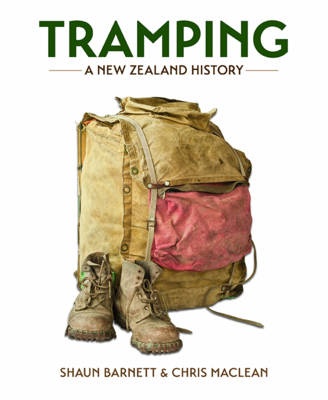
    cover_tramping_nz_history

    It’s no wonder that someone has finally attempted to exploit the seriously under-represented genre of comprehensive authoritative histories about tramping in the form of large coffee table books. The result is Chris Maclean’s and Shaun Barnett’s Tramping – A New Zealand History.

    I first heard of this book shortly before a seminar given by the authors in September 2013. I attended the seminar, and left with optimism. A year later, the book was released. It displays a Mountain Mule and a pair of old boots on the cover. The book weighs 2.5 kg.

    Below are my thoughts, and I’ve tried really hard to keep these thoughts shorter than the book itself. If you’re interested, some alternative sources of info are the book’s official Facebook page, an interview by Kim Hill with the authors that was broadcast on Radio NZ, a book extract published in the NZ Herald, or brief reviews on NZ Bush Adventures, Beatties Book Blog, the Otago Daily Times, and Wild Magazine.
    (more…)

  • Collins Ultimate Navigation Manual, by Lyle Brotherton (a review)

    Collins Ultimate Navigation Manual, by Lyle Brotherton

    I don’t normally refer to material without a direct New Zealand connection, but I’ve made an exception in this case. In my kiwi-centric world (at least on this website) I’m very interested in outdoor navigation. Globally the Collins Ultimate Navigation Manual by Lyle Brotherton is a highly recommended resource. I haven’t seen it on retail shelves in New Zealand, but it’s accessible fairly cheaply with an online order via an NZ web retailer such as Fishpond, although you’ll need to wait for the book to be mailed from the UK

    I was excited when I first heard about this book. I’ve seen it informally referred to as something that resembles a complete and authoritative guide to navigation. The book itself doesn’t state this, but still claims via its preface to be “the most comprehensive and easy-to-use navigation manual ever made available”, and “a landmark in land navigation”.

    More specifically, the book considers what its author refers to as “micronavigation”, which is essentially described as [my translation] the form of land navigation that involves connecting together short legs of movement through a terrestrial environment to successfully form a lengthier journey. In other words, it’s a guide to virtually all types and tricks of navigation that are normally required for finding one’s way through the back-country.
    (more…)

  • Safety In The Mountains (review)

    Safety in the Mountains, 11th edition cover

    I’ve never read a copy of Safety in the Mountains until now. It’s a booklet, first published in 1937 by Federated Mountain Clubs (FMC), to collect important points of safety for exploring the back-country, and designed as a carry-with-you reference guide. Over 75 years, 130,000 copies have now been printed. The 11th and latest edition of 2012 was launched earlier this month.

    Not having read previous editions makes me inadequate to comment on changes or make other comparisons with what came before, so here I express my impressions of the 11th edition from an isolated viewpoint. I’ll also state a disclaimer for a potential conflict of interest, because I’m indirectly a member of Federated Mountain Clubs (via the Wellington Tramping & Mountaineering Club), and tend to be aligned with much of its advocacy.

    About the book

    The text says it best: “This booklet is intended as a collection of reminders for use in the field rather than to replace any instruction manual, or textbook. They are for the guidance of readers and are binding on fools.”

    (more…)

  • Rivers and Ropes and Mutual Support

    I’ve written a little about river crossing techniques in the past, and I’m about to do so again. Before continuing, I’d like to stress that this post is not meant to be instructional in any way, so much as commenting on some recent happenings in the world of river safety techniques. Back-country rivers are dangerous beasts that kill people who make mistakes. Judging and crossing rivers safely in an outdoors situation is a delicate skill, and the best way to learn it is through river safety courses and by getting experience in controlled situations with experienced people.

    That said, there’s an interesting discussion developing through Federated Mountain Clubs, and highlighted in the November 2011 FMC Bulletin. In it, FMC have published a condensed edition of a report by Brian Wilkins regarding the fording of rivers. It’d be fair to say that Brian is very critical of the Mountain Safety Council’s training materials for the past 20 years which focus on mutual support methods for crossing rivers, and he proposes a return to sufficient training for rope use as an option. The abbreviated article in the printed FMC Bulletin is diplomatic, but FMC have also made the complete 32 page write-up available as a PDF downloadable from their website, and certain parts of it certainly aren’t diplomatic.

    Before continuing (and please remember this when reading what follows), I should stress that the New Zealand Mountain Safety Council has since responded to Brian Wilkins’ article with a statement issued on 9th December 2011 (PDF), explaining why it pushes mutual support methods and avoids rope techniques. In short, mutual support methods have been carefully developed by experts over a long period of time, after many trials it was decided that ropes can become very dangerous unless used correctly… which few people can do, and “it was concluded that ropes can give people a false impression of their abilities and can tempt people to try unsafe conditions”.

    The entirety of the debate is an interesting read.
    (more…)

  • NZMS 260 and 262: Our Metric Topographical Heritage, edited by Graeme Jupp (review)

    Topographic maps worldwide often appear utilitarian, if not a little boring graphically. By comparison the new 260s were stylish and modern without losing any utility. They were undoubtedly among the best looking topographic maps in the world.

    —David Balm, In Order to Make a Good Impression: Printing 260 series topographic maps, 1976-1984, (reproduced in the book being reviewed)

    Cover image of NZMS 260 and 262: Our Metric Topographical Heritage, edited by Graeme Jupp

    This is a review of Graeme Jupp’s recently published booklet, titled “NZMS 260 and 262: Our Metric Topographical Heritage”, which was published in February 2011 as part of the CartoPRESS series by the New Zealand Cartographic Society. I’m not giving a complete qualified review, because I’m neither a cartographer nor am I very familiar with much of the history the material to comment on accuracy. It’s more of a perspective from someone who’s enjoyed using New Zealand’s topo maps over the last few years from a tramping perspective. If anyone notices mistakes in some of my comments to do with mapping history or technical issues, please feel welcome to correct me in the comments below. An alternative review by Shaun Barnett has been published in FMC Bulletin 184 from June 2011 (see here for a download link), which has been republished by the NZ Cartographic Society.

    If you’ve spent any of the last several decades using New Zealand’s official topo maps to plan interesting trips, you might find a moment to turn an eye to a short collation of recent cartographic history. This book combines a history with a comprehensive tabular appendix of maps. The combination of the history and the tables means it will make a handy reference item to have on the shelf for many people with an interest.

    The 260 and 262 map series are now obsolete, having respectively been replaced by the Topo50 and Topo250 series as of September 2009, but until that time they became extremely popular, and many are still in circulation today. As concluded by the editor, more than 2.8 million maps of the 260 series, and a further 408,000 maps in the 262 series (which shared the same geodetic datum but was drawn to a different scale) were printed between 1978 and 2009. Production of the 260 and 262 series provided a platform, and also established techniques and technologies upon which New Zealand’s topographic map-making continues to be built. The influence of this period of time in the production of maps in New Zealand seems hard to argue with.
    (more…)

  • Huts: Untold stories from back-country New Zealand, by Mark Pickering (review)

    Huts, by Mark Pickering

    This is the second book I’ve read by Mark Pickering, the first having been A Tramper’s Journey, which I liked (the review is here). He’s written many books, and this is a topic that Mark Pickering is especially suited to, having a strong interest in huts and having visited over 1000 back-country huts already. His latest book was released in time for Christmas 2010. Huts: Untold stories from back-country New Zealand retails for $50, or $49.99 if you take the effort to shop around.

    Production quality is generally nice, with good authoring and editing, although see my comment below about printing. This book is very heavy. It’s a paperback, but don’t let that fool you. It’s 384 big pages on good, glossy paper. Large numbers of photographs, often using half a page at a time, ensure the text isn’t too dense and the reading remains quite easy. Reading one or more chapters in a short sitting is very feasible. The weight and dimensions mean it’s not the sort of book that would typically be stuffed into a pack for weekend reading, except by people who like to show off.

    Background

    The title suggests that this is a book about huts. It is, but it’s even more-so a book about the history of the back-country, and how all of the 1000—1500 back-country huts (the exact number depends on one’s criteria for counting) came to be. The blurb on the back of the book begins with “If huts could talk, they could tell the whole history of the back-country”, and this is a good summary of what you’ll find inside. It’s a history built around the structures which, today, are mostly used for recreation.
    (more…)

  • Spooky Friday

    Friday. One day as I was walking to school I saw a track that I hadn't seen before. I don't know why but I just started to go down it. The track was very dark and gloomy. I had to go to school then but I am going back to that track another day with Fred. * Great Work Michael.

    It’s lacking in plot, and provides no explanation of this “Fred” person who’s suddenly been inflicted upon the protagonist. I don’t rate the narrative aspect of this novel highly.

    On the other hand, consider the correct use of full stops, apostrophes and capitalisation, as well as impressive adherence to keeping between the lines. Visible evidence of text erasure also shows the author’s commitment to appropriate spacing between words, despite battling with his own impatience to express ideas. Added together these elements ensured a star-spangled reception from the public.

    6/10.
  • Tararua Adventure Guide, by Jonathan Kennett (a few thoughts)

    Cover picture of Tararua Adventure Guide, by Jonathan Kennett

    The Tararua Adventure Guide, by Jonathan Kennett, was recently published in August 2010 by the Kennett Brothers. It’s available in a bunch of places such as outdoor shops, probably some bike shops given who’s publishing it, a few online bookstores if you search around, and allegedly good book shops. (I couldn’t find it in the likes of Whitcoulls or Borders, but no surprises there.) It cost me about $21.25 after an FMC affiliation discount, and for that I got a 152 page paperback handbook, including a 3 page index. The price was right!

    Bivouac in Wellington was sold out when I first visited to snap up a copy during September, but they had another shipment coming in the next day, and sure enough about 10 copies were displayed on the counter a day later. I guess it’s been a popular book. This should be expected because the Tararuas are on Wellington’s doorstep, and there’s not been much of an attempt at a decent route guidebook for ages, possibly not since Merv Rodgers’ Tararua Footprints of 1996. Please post a comment below if you think I’ve missed a recent good one in the past 15 years. I’ve not been on the scene long enough to be sure.

    An unlikely twist to my purchase was that I’d only just managed to track down my own copy of the 1996 Tararua Footprints about a week earlier, after several years of trying. The reason for this lack of guides that specifically target the Tararuas is probably the relatively localised market that is the greater Wellington region combined with the small proportion of people who often get into the outdoors to the extent of being able to benefit from such a guide. Few people beyond the lower North Island would buy such a book, and it’s a risk for a publishing company to run off the thousands of copies likely to be needed just to break even. The initial print run is 2000 copies, which is probably on the low side for most publishers. The Kennett Brothers have a recent history of publishing books to similar localised and niche markets, especially around mountain biking, so my guess would be that they’re probably in a better position to understand the audience and distribution channels, and could manage the risk better than less specialised publishers.

    About the book

    The Tararua Adventure Guide is a description of all the main things to do in the Tararua Range. It’s not restricted to tramping, and is more of an adventure guide as the title suggests. The author has filled about a third of the book with “classic tramps” of the Tararuas, and another quarter towards the end with additional popular tramps and less common routes. The rest is filled with ideas for short walks and daytrips, several good river explorations, a single canyoning adventure (Chamberlain Creak), a few pages on mountain runs and mountain bike rides, and two pages about hunting and fishing opportunities. That last one is more as an explanation than a guide for hunters, and only a paragraph of the section is actually about fishing. The book has photographs scattered throughout, as well as brief history notes here and there, helping to give a better feel for the areas being described.
    (more…)

  • A Trampers Journey by Mark Pickering (my notes)

    Several years ago I picked up this book by Mark Pickering titled A Tramper’s Journey, subtitled Stories from the back country of New Zealand, and noticed the entire opening section was all about the author’s 1970s experience in Tongue & Meats, also known as the Wellington Tramping & Mountaineering Club. (Its slang name was adopted from a local butchery in the early days that had the same initials.) With this being a club I’d recently joined, I bought it and began rushing through the early pages, keen to pick out any names I might recognise. Before long the author began to venture into other parts of his experience which I hadn’t been able to relate to very well, and at that time my interest was distracted by other things. Recently I re-discovered it on my bookshelf, read through the entire thing, and noticed many more aspects of this book that now resonate.

    The book was published in 2004 and as far as I know hasn’t been reprinted, so it’s now 6 years old. I do still see it on occasion being sold in bookshops as a new book, so I think it’s still available, or should at the very least be easily found in most New Zealand libraries. [Edit 25-Mar-2012: An electronic PDF copy of the entire book is now available for download from the author’s website.] It totals just under 200 pages of relatively easy reading that’s divided into so many distinct sections that it’s easy to pick up and put down for short stints. My paperback copy is on good quality paper. I thought it was heavier than it looked as if it should have been when I took it tramping a couple of weeks ago.

    This is a tribute book to tramping more than anything else. Unlike similar books on the shelves, this one isn’t about climbing or mountaineering, and it’s not about hunting. Mark Pickering himself commented that while there are a plethora of journals and newsletters and several guide-books that include elements of story telling, there are very few books specifically devoted to tramping stories. What he’s produced is a semi-autobiographical combination of stories that mostly, but not exclusively relate to his experiences of tramping all over New Zealand. Over 30 years between 1974 and 2004, he tallied visits to about 900 distinct huts, and learned a lot of history and stories to go with his experience.

    The book is structured into a combination of stories, trivia, and both anecdotes and larger explanations of tramping history. The author is a self-confessed history buff. All these elements are structured between eight chapters that group related topics, and with each chapter clearly divided into several sections. Sometimes the association of the section with the chapter is generous. Mark Pickering’s story about his discovery of a gold mine of old maps seems to be affiliated with his chapter about tramping in the Canterbury back-country on the thin premise that the second hand bookshop with the maps happened to be in Christchurch. It doesn’t really matter though, because that’s exactly what this book is — a journey of loosely connected anecdotes and stories laid out in a way for the reader to flow between, to gather an appreciation of why people go tramping, what’s important, and how things work in the back-country.
    (more…)